



𝐅𝐈𝐑𝐄𝐒𝐓𝐀𝐑𝐓𝐄𝐑 𝐅𝐑𝐈𝐃𝐀𝐘 𝐂𝐀𝐋𝐋 𝐑𝐄𝐂𝐀𝐏 𝟏𝟔 𝐉𝐚𝐧𝐮𝐚𝐫𝐲 𝟐𝟎𝟐𝟔
This call was powerful — and it explains exactly why LiveGood continues to grow when others don’t.
Every time it feels like things might slow down… they don’t. We may see brief lulls, but then the momentum takes off again. Another huge Friday. Another strong week. That doesn’t happen by accident.
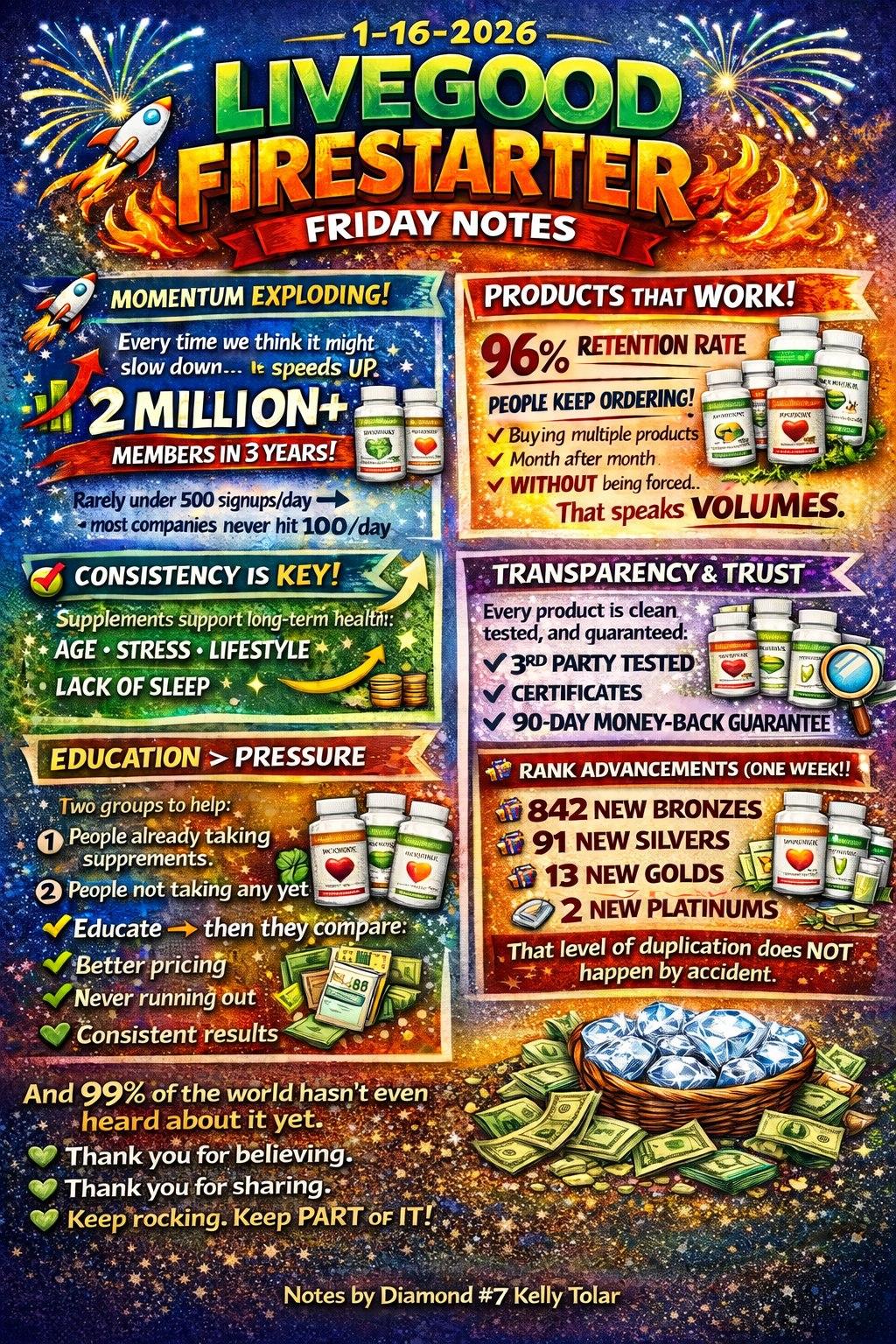
2+ MILLION members in just 3 years
Rarely under 500 signups per day
Most companies never hit 100 signups per day in their lifetime
This isn’t hype — this is documentation.
𝐏𝐑𝐎𝐃𝐔𝐂𝐓𝐒 𝐓𝐇𝐀𝐓 𝐖𝐎𝐑𝐊 = 𝐑𝐄𝐓𝐄𝐍𝐓𝐈𝐎𝐍
People are not required to buy products… yet they’re:
ordering multiple products
subscribing more than ever
reordering month after month
That’s why LiveGood has a 96% retention rate.
People don’t keep buying products that don’t work.
Consistency matters. Supplements aren’t a 30-day fix — they support the body long-term, especially with aging, stress, lifestyle demands, and lack of sleep. That’s why Subscribe & Save exists — not to trap people, but to help them stay consistent and save money.
𝐄𝐃𝐔𝐂𝐀𝐓𝐈𝐎𝐍 𝐂𝐎𝐍𝐕𝐄𝐑𝐓𝐒 — 𝐍𝐎𝐓 𝐏𝐑𝐄𝐒𝐒𝐔𝐑𝐄
There are two groups of people:
1️⃣ Those already taking supplements
2️⃣ Those not taking any yet
For supplement users, price catches attention — but quality, testing, and transparency create trust.
For non-users, education comes first — and once they understand why supplements matter, LiveGood becomes the easy choice.
Even doctors today commonly recommend:
• Vitamin D
• Omegas (Factor 4)
• A daily multivitamin
• Magnesium
Education opens the door. Value closes it.
And for the business-only mindset?
They can join without buying anything — yet many end up using products after attending trainings and seeing results.
𝐓𝐑𝐀𝐍𝐒𝐏𝐀𝐑𝐄𝐍𝐂𝐘 𝐁𝐔𝐈𝐋𝐃𝐒 𝐂𝐎𝐍𝐅𝐈𝐃𝐄𝐍𝐂𝐄
Most companies say “trust us.”
LiveGood shows:
3rd-party testing
Certificates of Analysis
Clean, fully disclosed formulas
90-day empty bottle money-back guarantee
And almost no one uses it — because the products work.
𝐑𝐀𝐍𝐊 𝐀𝐃𝐕𝐀𝐍𝐂𝐄𝐌𝐄𝐍𝐓𝐒 — 𝐎𝐍𝐄 𝐖𝐄𝐄𝐊
842 NEW BRONZES
91 NEW SILVERS
13 NEW GOLDS
2 NEW PLATINUMS
That level of duplication does NOT happen by accident.
This is what happens when:
• products make sense
• pricing makes sense
• the system is simple
𝐈𝐍𝐃𝐔𝐒𝐓𝐑𝐘 𝐃𝐈𝐒𝐑𝐔𝐏𝐓𝐈𝐎𝐍 𝐈𝐒 𝐑𝐄𝐀𝐋
LiveGood doesn’t rely on hype events, conventions, or gimmicks. We don’t do fake discounts or inflated pricing. Our everyday prices beat most companies’ “best sales.”
Example shared on the call:
Super Reds cost about $13–14 to make and sell for $19.95 — fully transparent. You can’t compete with that unless you cut quality or hide formulas.
And the industry has noticed.
New supplement companies have nearly stopped launching. The space has gone quiet — because overpriced products don’t work anymore.
𝐖𝐇𝐀𝐓’𝐒 𝐂𝐎𝐌𝐈𝐍𝐆
• NAD is live — do your homework
• Molecular Hydrogen & Parasite Cleanse coming
• Advertising and co-op expanding
• Weekly video trainings launching
• Amazon funnel feeding new members into LiveGood
And yes — 99% of the world hasn’t even heard about LiveGood yet.
𝐋𝐎𝐍𝐆-𝐓𝐄𝐑𝐌 𝐕𝐈𝐒𝐈𝐎𝐍
Most companies churn people every 2–3 months. LiveGood keeps people for years. That’s how true residual income is built — income that can still be paying 10, 20, even 50+ years down the road.
This is different.
This is sustainable.
And we’re just getting started.
Thank you for believing.
Thank you for sharing.
Thank you for being part of it.
Keep rocking. Keep cranking. See you Monday. See you at the top.
This call was powerful — and it explains exactly why LiveGood continues to grow when others don’t.
Every time it feels like things might slow down… they don’t. We may see brief lulls, but then the momentum takes off again. Another huge Friday. Another strong week. That doesn’t happen by accident.
2+ MILLION members in just 3 years
Rarely under 500 signups per day
Most companies never hit 100 signups per day in their lifetime
This isn’t hype — this is documentation.
𝐏𝐑𝐎𝐃𝐔𝐂𝐓𝐒 𝐓𝐇𝐀𝐓 𝐖𝐎𝐑𝐊 = 𝐑𝐄𝐓𝐄𝐍𝐓𝐈𝐎𝐍
People are not required to buy products… yet they’re:
ordering multiple products
subscribing more than ever
reordering month after month
That’s why LiveGood has a 96% retention rate.
People don’t keep buying products that don’t work.
Consistency matters. Supplements aren’t a 30-day fix — they support the body long-term, especially with aging, stress, lifestyle demands, and lack of sleep. That’s why Subscribe & Save exists — not to trap people, but to help them stay consistent and save money.
𝐄𝐃𝐔𝐂𝐀𝐓𝐈𝐎𝐍 𝐂𝐎𝐍𝐕𝐄𝐑𝐓𝐒 — 𝐍𝐎𝐓 𝐏𝐑𝐄𝐒𝐒𝐔𝐑𝐄
There are two groups of people:
1️⃣ Those already taking supplements
2️⃣ Those not taking any yet
For supplement users, price catches attention — but quality, testing, and transparency create trust.
For non-users, education comes first — and once they understand why supplements matter, LiveGood becomes the easy choice.
Even doctors today commonly recommend:
• Vitamin D
• Omegas (Factor 4)
• A daily multivitamin
• Magnesium
Education opens the door. Value closes it.
And for the business-only mindset?
They can join without buying anything — yet many end up using products after attending trainings and seeing results.
𝐓𝐑𝐀𝐍𝐒𝐏𝐀𝐑𝐄𝐍𝐂𝐘 𝐁𝐔𝐈𝐋𝐃𝐒 𝐂𝐎𝐍𝐅𝐈𝐃𝐄𝐍𝐂𝐄
Most companies say “trust us.”
LiveGood shows:
3rd-party testing
Certificates of Analysis
Clean, fully disclosed formulas
90-day empty bottle money-back guarantee
And almost no one uses it — because the products work.
𝐑𝐀𝐍𝐊 𝐀𝐃𝐕𝐀𝐍𝐂𝐄𝐌𝐄𝐍𝐓𝐒 — 𝐎𝐍𝐄 𝐖𝐄𝐄𝐊
842 NEW BRONZES
91 NEW SILVERS
13 NEW GOLDS
2 NEW PLATINUMS
That level of duplication does NOT happen by accident.
This is what happens when:
• products make sense
• pricing makes sense
• the system is simple
𝐈𝐍𝐃𝐔𝐒𝐓𝐑𝐘 𝐃𝐈𝐒𝐑𝐔𝐏𝐓𝐈𝐎𝐍 𝐈𝐒 𝐑𝐄𝐀𝐋
LiveGood doesn’t rely on hype events, conventions, or gimmicks. We don’t do fake discounts or inflated pricing. Our everyday prices beat most companies’ “best sales.”
Example shared on the call:
Super Reds cost about $13–14 to make and sell for $19.95 — fully transparent. You can’t compete with that unless you cut quality or hide formulas.
And the industry has noticed.
New supplement companies have nearly stopped launching. The space has gone quiet — because overpriced products don’t work anymore.
𝐖𝐇𝐀𝐓’𝐒 𝐂𝐎𝐌𝐈𝐍𝐆
• NAD is live — do your homework
• Molecular Hydrogen & Parasite Cleanse coming
• Advertising and co-op expanding
• Weekly video trainings launching
• Amazon funnel feeding new members into LiveGood
And yes — 99% of the world hasn’t even heard about LiveGood yet.
𝐋𝐎𝐍𝐆-𝐓𝐄𝐑𝐌 𝐕𝐈𝐒𝐈𝐎𝐍
Most companies churn people every 2–3 months. LiveGood keeps people for years. That’s how true residual income is built — income that can still be paying 10, 20, even 50+ years down the road.
This is different.
This is sustainable.
And we’re just getting started.
Thank you for believing.
Thank you for sharing.
Thank you for being part of it.
Keep rocking. Keep cranking. See you Monday. See you at the top.
🔥 𝐅𝐈𝐑𝐄𝐒𝐓𝐀𝐑𝐓𝐄𝐑 𝐅𝐑𝐈𝐃𝐀𝐘 𝐂𝐀𝐋𝐋 𝐑𝐄𝐂𝐀𝐏 𝟏𝟔 𝐉𝐚𝐧𝐮𝐚𝐫𝐲 𝟐𝟎𝟐𝟔 🔥
This call was powerful — and it explains exactly why LiveGood continues to grow when others don’t.
Every time it feels like things might slow down… they don’t. We may see brief lulls, but then the momentum takes off again. Another huge Friday. Another strong week. That doesn’t happen by accident.
💥 2+ MILLION members in just 3 years
💥 Rarely under 500 signups per day
💥 Most companies never hit 100 signups per day in their lifetime
This isn’t hype — this is documentation.
🧬 𝐏𝐑𝐎𝐃𝐔𝐂𝐓𝐒 𝐓𝐇𝐀𝐓 𝐖𝐎𝐑𝐊 = 𝐑𝐄𝐓𝐄𝐍𝐓𝐈𝐎𝐍
People are not required to buy products… yet they’re:
✔️ ordering multiple products
✔️ subscribing more than ever
✔️ reordering month after month
That’s why LiveGood has a 96% retention rate.
People don’t keep buying products that don’t work.
Consistency matters. Supplements aren’t a 30-day fix — they support the body long-term, especially with aging, stress, lifestyle demands, and lack of sleep. That’s why Subscribe & Save exists — not to trap people, but to help them stay consistent and save money.
🎓 𝐄𝐃𝐔𝐂𝐀𝐓𝐈𝐎𝐍 𝐂𝐎𝐍𝐕𝐄𝐑𝐓𝐒 — 𝐍𝐎𝐓 𝐏𝐑𝐄𝐒𝐒𝐔𝐑𝐄
There are two groups of people:
1️⃣ Those already taking supplements
2️⃣ Those not taking any yet
For supplement users, price catches attention — but quality, testing, and transparency create trust.
For non-users, education comes first — and once they understand why supplements matter, LiveGood becomes the easy choice.
Even doctors today commonly recommend:
• Vitamin D
• Omegas (Factor 4)
• A daily multivitamin
• Magnesium
Education opens the door. Value closes it.
And for the business-only mindset?
They can join without buying anything — yet many end up using products after attending trainings and seeing results.
🧪 𝐓𝐑𝐀𝐍𝐒𝐏𝐀𝐑𝐄𝐍𝐂𝐘 𝐁𝐔𝐈𝐋𝐃𝐒 𝐂𝐎𝐍𝐅𝐈𝐃𝐄𝐍𝐂𝐄
Most companies say “trust us.”
LiveGood shows:
✔️ 3rd-party testing
✔️ Certificates of Analysis
✔️ Clean, fully disclosed formulas
✔️ 90-day empty bottle money-back guarantee
And almost no one uses it — because the products work.
🏆 𝐑𝐀𝐍𝐊 𝐀𝐃𝐕𝐀𝐍𝐂𝐄𝐌𝐄𝐍𝐓𝐒 — 𝐎𝐍𝐄 𝐖𝐄𝐄𝐊
🎉 842 NEW BRONZES
🎉 91 NEW SILVERS
🎉 13 NEW GOLDS
🎉 2 NEW PLATINUMS
That level of duplication does NOT happen by accident.
This is what happens when:
• products make sense
• pricing makes sense
• the system is simple
🌍 𝐈𝐍𝐃𝐔𝐒𝐓𝐑𝐘 𝐃𝐈𝐒𝐑𝐔𝐏𝐓𝐈𝐎𝐍 𝐈𝐒 𝐑𝐄𝐀𝐋
LiveGood doesn’t rely on hype events, conventions, or gimmicks. We don’t do fake discounts or inflated pricing. Our everyday prices beat most companies’ “best sales.”
Example shared on the call:
Super Reds cost about $13–14 to make and sell for $19.95 — fully transparent. You can’t compete with that unless you cut quality or hide formulas.
And the industry has noticed.
New supplement companies have nearly stopped launching. The space has gone quiet — because overpriced products don’t work anymore.
📢 𝐖𝐇𝐀𝐓’𝐒 𝐂𝐎𝐌𝐈𝐍𝐆
• NAD is live — do your homework
• Molecular Hydrogen & Parasite Cleanse coming
• Advertising and co-op expanding
• Weekly video trainings launching
• Amazon funnel feeding new members into LiveGood
And yes — 99% of the world hasn’t even heard about LiveGood yet.
💎 𝐋𝐎𝐍𝐆-𝐓𝐄𝐑𝐌 𝐕𝐈𝐒𝐈𝐎𝐍
Most companies churn people every 2–3 months. LiveGood keeps people for years. That’s how true residual income is built — income that can still be paying 10, 20, even 50+ years down the road.
This is different.
This is sustainable.
And we’re just getting started.
💚 Thank you for believing.
💚 Thank you for sharing.
💚 Thank you for being part of it.
🔥 Keep rocking. Keep cranking. See you Monday. See you at the top. 🔥
1 Commenti
0 condivisioni
1K Views




.png)


 English
 Arabic
 French
 Spanish
 Portuguese
 Deutsch
 Turkish
 Dutch
Dutch
 Russian
 Romaian
 Portuguese (Brazil)
 Greek
Greek