

• Welcome to the Promotion Hub!
    We’re glad you’re here!
    This community is all about visibility, connection, and growth. If you’re building something — a business, program, course, service, tool, or project — you’re in the right place. This is a space where sharing what you’ve created is not just allowed… it’s encouraged.
    We use Skool to keep everything organized but remember — this group is about discovering opportunities beyond just one platform. You’ll find a mix of businesses, programs, tools, communities, and ideas from all over.
    First Step — Introduce Yourself
    Drop a comment below and tell us:
    • Who you are• What you’re working on• Who your offer helps
    This helps members connect with the right people faster.
    Ready to Share?
    Go ahead and post about:
    Your business Your services or offers Your courses or programs Your website, app, or tool Your community (including Skool groups)
    Just make sure to include a short description so people know what it’s about — not just a link.
    How to Get the Most Out of This Group
    The more you engage, the more visibility you’ll get.
    • Support other members• Ask questions• Leave feedback• Make connections
    This isn’t just a link-sharing space — it’s a network of builders helping each other grow.
    Let’s Build Together
    Everyone here is working toward something. Share your work, explore what others are building, and take advantage of the opportunity to connect.
    Welcome to the community — now jump in and introduce yourself below!
    https://www.skool.com/programs-other-then-skool-3667/about
    🎉 Welcome to the Promotion Hub! We’re glad you’re here! This community is all about visibility, connection, and growth. If you’re building something — a business, program, course, service, tool, or project — you’re in the right place. This is a space where sharing what you’ve created is not just allowed… it’s encouraged. We use Skool to keep everything organized but remember — this group is about discovering opportunities beyond just one platform. You’ll find a mix of businesses, programs, tools, communities, and ideas from all over. 👋 First Step — Introduce Yourself Drop a comment below and tell us: • Who you are• What you’re working on• Who your offer helps This helps members connect with the right people faster. 📣 Ready to Share? Go ahead and post about: ✅ Your business✅ Your services or offers✅ Your courses or programs✅ Your website, app, or tool✅ Your community (including Skool groups) Just make sure to include a short description so people know what it’s about — not just a link. 🤝 How to Get the Most Out of This Group The more you engage, the more visibility you’ll get. • Support other members• Ask questions• Leave feedback• Make connections This isn’t just a link-sharing space — it’s a network of builders helping each other grow. 🚀 Let’s Build Together Everyone here is working toward something. Share your work, explore what others are building, and take advantage of the opportunity to connect. Welcome to the community — now jump in and introduce yourself below! 👇 https://www.skool.com/programs-other-then-skool-3667/about

    0 Comentários 0 Compartilhamentos 1K Visualizações

  • Welcome to the Promotion Hub!
    This community is all about visibility, connection, and growth. If you’re building something — a business, program, course, service, tool, or project — you’re in the right place. This is a space where sharing what you’ve created is not just allowed… it’s encouraged.
    We use Skool to keep everything organized but remember — this group is about discovering opportunities beyond just one platform. You’ll find a mix of businesses, programs, tools, communities, and ideas from all over.
    Ready to Share?
    Go ahead and post about:
    Your business Your services or offers Your courses or programs Your website, app, or tool Your community (including Skool groups)
    Just make sure to include a short description so people know what it’s about — not just a link.
    How to Get the Most Out of This Group
    The more you engage, the more visibility you’ll get.
    • Support other members• Ask questions• Leave feedback• Make connections
    This isn’t just a link-sharing space — it’s a network of builders helping each other grow.
    Let’s Build Together
    Everyone here is working toward something. Share your work, explore what others are building, and take advantage of the opportunity to connect.
    Welcome to the community — now jump in and connect.
    https://www.skool.com/programs-other-then-skool-3667/about
    🎉 Welcome to the Promotion Hub! This community is all about visibility, connection, and growth. If you’re building something — a business, program, course, service, tool, or project — you’re in the right place. This is a space where sharing what you’ve created is not just allowed… it’s encouraged. We use Skool to keep everything organized but remember — this group is about discovering opportunities beyond just one platform. You’ll find a mix of businesses, programs, tools, communities, and ideas from all over. 📣 Ready to Share? Go ahead and post about: ✅ Your business✅ Your services or offers✅ Your courses or programs✅ Your website, app, or tool✅ Your community (including Skool groups) Just make sure to include a short description so people know what it’s about — not just a link. 🤝 How to Get the Most Out of This Group The more you engage, the more visibility you’ll get. • Support other members• Ask questions• Leave feedback• Make connections This isn’t just a link-sharing space — it’s a network of builders helping each other grow. 🚀 Let’s Build Together Everyone here is working toward something. Share your work, explore what others are building, and take advantage of the opportunity to connect. Welcome to the community — now jump in and connect. 👇 https://www.skool.com/programs-other-then-skool-3667/about
    Love
    1
    0 Comentários 0 Compartilhamentos 1K Visualizações
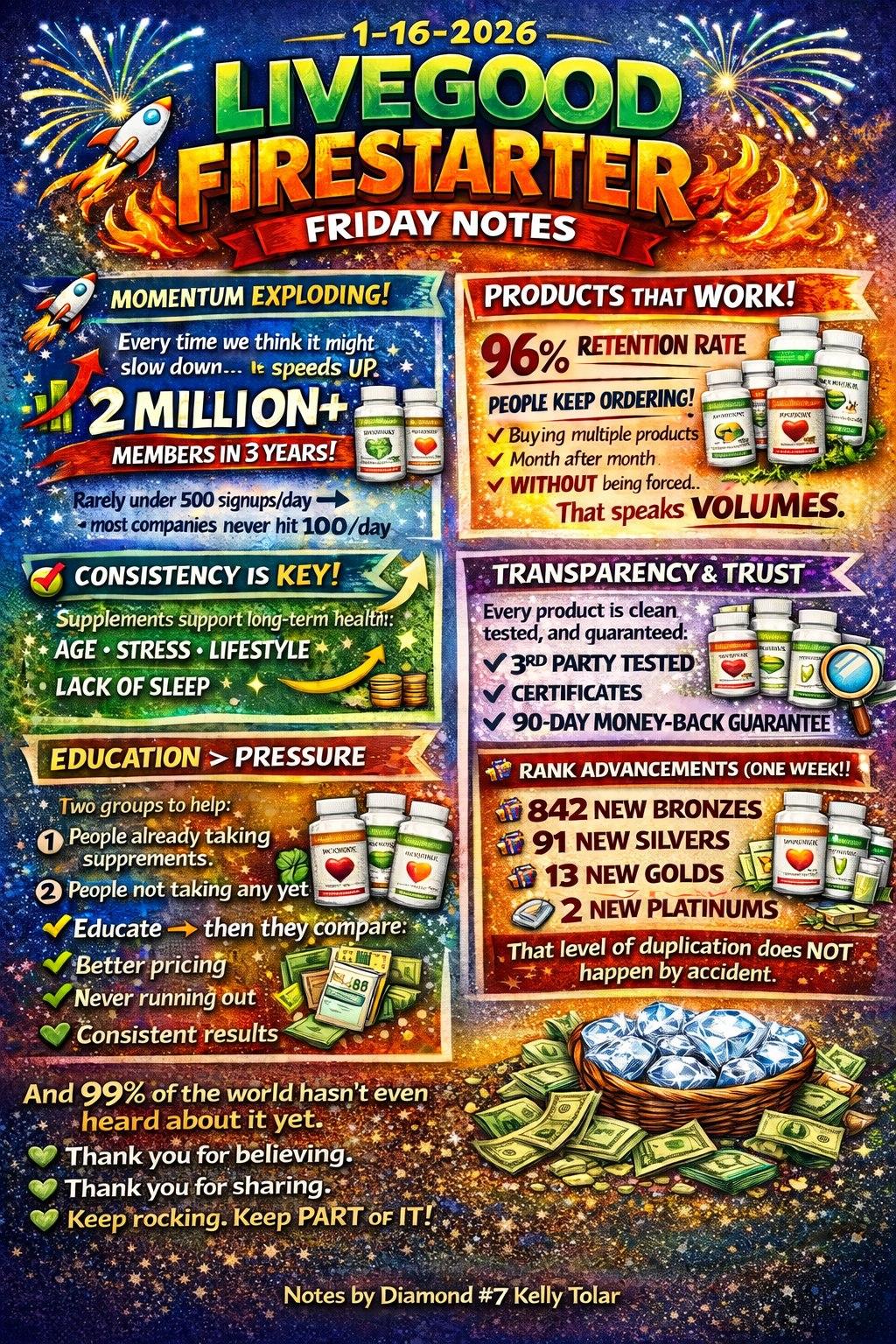
  • 𝐅𝐈𝐑𝐄𝐒𝐓𝐀𝐑𝐓𝐄𝐑 𝐅𝐑𝐈𝐃𝐀𝐘 𝐂𝐀𝐋𝐋 𝐑𝐄𝐂𝐀𝐏 𝟏𝟔 𝐉𝐚𝐧𝐮𝐚𝐫𝐲 𝟐𝟎𝟐𝟔

    This call was powerful — and it explains exactly why LiveGood continues to grow when others don’t.⁣
    Every time it feels like things might slow down… they don’t. We may see brief lulls, but then the momentum takes off again. Another huge Friday. Another strong week. That doesn’t happen by accident.⁣
    2+ MILLION members in just 3 years⁣
    Rarely under 500 signups per day⁣
    Most companies never hit 100 signups per day in their lifetime⁣
    This isn’t hype — this is documentation.⁣

    𝐏𝐑𝐎𝐃𝐔𝐂𝐓𝐒 𝐓𝐇𝐀𝐓 𝐖𝐎𝐑𝐊 = 𝐑𝐄𝐓𝐄𝐍𝐓𝐈𝐎𝐍⁣
    People are not required to buy products… yet they’re:⁣
    ordering multiple products⁣
    subscribing more than ever⁣
    reordering month after month⁣
    That’s why LiveGood has a 96% retention rate.⁣
    People don’t keep buying products that don’t work.⁣
    Consistency matters. Supplements aren’t a 30-day fix — they support the body long-term, especially with aging, stress, lifestyle demands, and lack of sleep. That’s why Subscribe & Save exists — not to trap people, but to help them stay consistent and save money.⁣

    𝐄𝐃𝐔𝐂𝐀𝐓𝐈𝐎𝐍 𝐂𝐎𝐍𝐕𝐄𝐑𝐓𝐒 — 𝐍𝐎𝐓 𝐏𝐑𝐄𝐒𝐒𝐔𝐑𝐄⁣
    There are two groups of people:⁣
    1️⃣ Those already taking supplements⁣
    2️⃣ Those not taking any yet⁣
    For supplement users, price catches attention — but quality, testing, and transparency create trust.⁣
    For non-users, education comes first — and once they understand why supplements matter, LiveGood becomes the easy choice.⁣
    Even doctors today commonly recommend:⁣
    • Vitamin D⁣
    • Omegas (Factor 4)⁣
    • A daily multivitamin⁣
    • Magnesium⁣
    Education opens the door. Value closes it.⁣
    And for the business-only mindset?⁣
    They can join without buying anything — yet many end up using products after attending trainings and seeing results.⁣

    𝐓𝐑𝐀𝐍𝐒𝐏𝐀𝐑𝐄𝐍𝐂𝐘 𝐁𝐔𝐈𝐋𝐃𝐒 𝐂𝐎𝐍𝐅𝐈𝐃𝐄𝐍𝐂𝐄⁣
    Most companies say “trust us.”⁣
    LiveGood shows:⁣
    3rd-party testing⁣
    Certificates of Analysis⁣
    Clean, fully disclosed formulas⁣
    90-day empty bottle money-back guarantee⁣
    And almost no one uses it — because the products work.⁣

    𝐑𝐀𝐍𝐊 𝐀𝐃𝐕𝐀𝐍𝐂𝐄𝐌𝐄𝐍𝐓𝐒 — 𝐎𝐍𝐄 𝐖𝐄𝐄𝐊⁣
    842 NEW BRONZES⁣
    91 NEW SILVERS⁣
    13 NEW GOLDS⁣
    2 NEW PLATINUMS⁣

    That level of duplication does NOT happen by accident.⁣
    This is what happens when:⁣
    • products make sense⁣
    • pricing makes sense⁣
    • the system is simple⁣

    𝐈𝐍𝐃𝐔𝐒𝐓𝐑𝐘 𝐃𝐈𝐒𝐑𝐔𝐏𝐓𝐈𝐎𝐍 𝐈𝐒 𝐑𝐄𝐀𝐋⁣
    LiveGood doesn’t rely on hype events, conventions, or gimmicks. We don’t do fake discounts or inflated pricing. Our everyday prices beat most companies’ “best sales.”⁣
    Example shared on the call:⁣
    Super Reds cost about $13–14 to make and sell for $19.95 — fully transparent. You can’t compete with that unless you cut quality or hide formulas.⁣
    And the industry has noticed.⁣
    New supplement companies have nearly stopped launching. The space has gone quiet — because overpriced products don’t work anymore.⁣

    𝐖𝐇𝐀𝐓’𝐒 𝐂𝐎𝐌𝐈𝐍𝐆⁣
    • NAD is live — do your homework⁣
    • Molecular Hydrogen & Parasite Cleanse coming⁣
    • Advertising and co-op expanding⁣
    • Weekly video trainings launching⁣
    • Amazon funnel feeding new members into LiveGood⁣
    And yes — 99% of the world hasn’t even heard about LiveGood yet.⁣

    𝐋𝐎𝐍𝐆-𝐓𝐄𝐑𝐌 𝐕𝐈𝐒𝐈𝐎𝐍⁣
    Most companies churn people every 2–3 months. LiveGood keeps people for years. That’s how true residual income is built — income that can still be paying 10, 20, even 50+ years down the road.⁣
    This is different.⁣
    This is sustainable.⁣
    And we’re just getting started.⁣

    Thank you for believing.⁣
    Thank you for sharing.⁣
    Thank you for being part of it.⁣

    Keep rocking. Keep cranking. See you Monday. See you at the top.
    🔥 𝐅𝐈𝐑𝐄𝐒𝐓𝐀𝐑𝐓𝐄𝐑 𝐅𝐑𝐈𝐃𝐀𝐘 𝐂𝐀𝐋𝐋 𝐑𝐄𝐂𝐀𝐏 𝟏𝟔 𝐉𝐚𝐧𝐮𝐚𝐫𝐲 𝟐𝟎𝟐𝟔 🔥⁣ ⁣ This call was powerful — and it explains exactly why LiveGood continues to grow when others don’t.⁣ Every time it feels like things might slow down… they don’t. We may see brief lulls, but then the momentum takes off again. Another huge Friday. Another strong week. That doesn’t happen by accident.⁣ 💥 2+ MILLION members in just 3 years⁣ 💥 Rarely under 500 signups per day⁣ 💥 Most companies never hit 100 signups per day in their lifetime⁣ This isn’t hype — this is documentation.⁣ ⁣ 🧬 𝐏𝐑𝐎𝐃𝐔𝐂𝐓𝐒 𝐓𝐇𝐀𝐓 𝐖𝐎𝐑𝐊 = 𝐑𝐄𝐓𝐄𝐍𝐓𝐈𝐎𝐍⁣ People are not required to buy products… yet they’re:⁣ ✔️ ordering multiple products⁣ ✔️ subscribing more than ever⁣ ✔️ reordering month after month⁣ That’s why LiveGood has a 96% retention rate.⁣ People don’t keep buying products that don’t work.⁣ Consistency matters. Supplements aren’t a 30-day fix — they support the body long-term, especially with aging, stress, lifestyle demands, and lack of sleep. That’s why Subscribe & Save exists — not to trap people, but to help them stay consistent and save money.⁣ ⁣ 🎓 𝐄𝐃𝐔𝐂𝐀𝐓𝐈𝐎𝐍 𝐂𝐎𝐍𝐕𝐄𝐑𝐓𝐒 — 𝐍𝐎𝐓 𝐏𝐑𝐄𝐒𝐒𝐔𝐑𝐄⁣ There are two groups of people:⁣ 1️⃣ Those already taking supplements⁣ 2️⃣ Those not taking any yet⁣ For supplement users, price catches attention — but quality, testing, and transparency create trust.⁣ For non-users, education comes first — and once they understand why supplements matter, LiveGood becomes the easy choice.⁣ Even doctors today commonly recommend:⁣ • Vitamin D⁣ • Omegas (Factor 4)⁣ • A daily multivitamin⁣ • Magnesium⁣ Education opens the door. Value closes it.⁣ And for the business-only mindset?⁣ They can join without buying anything — yet many end up using products after attending trainings and seeing results.⁣ ⁣ 🧪 𝐓𝐑𝐀𝐍𝐒𝐏𝐀𝐑𝐄𝐍𝐂𝐘 𝐁𝐔𝐈𝐋𝐃𝐒 𝐂𝐎𝐍𝐅𝐈𝐃𝐄𝐍𝐂𝐄⁣ Most companies say “trust us.”⁣ LiveGood shows:⁣ ✔️ 3rd-party testing⁣ ✔️ Certificates of Analysis⁣ ✔️ Clean, fully disclosed formulas⁣ ✔️ 90-day empty bottle money-back guarantee⁣ And almost no one uses it — because the products work.⁣ ⁣ 🏆 𝐑𝐀𝐍𝐊 𝐀𝐃𝐕𝐀𝐍𝐂𝐄𝐌𝐄𝐍𝐓𝐒 — 𝐎𝐍𝐄 𝐖𝐄𝐄𝐊⁣ 🎉 842 NEW BRONZES⁣ 🎉 91 NEW SILVERS⁣ 🎉 13 NEW GOLDS⁣ 🎉 2 NEW PLATINUMS⁣ ⁣ That level of duplication does NOT happen by accident.⁣ This is what happens when:⁣ • products make sense⁣ • pricing makes sense⁣ • the system is simple⁣ ⁣ 🌍 𝐈𝐍𝐃𝐔𝐒𝐓𝐑𝐘 𝐃𝐈𝐒𝐑𝐔𝐏𝐓𝐈𝐎𝐍 𝐈𝐒 𝐑𝐄𝐀𝐋⁣ LiveGood doesn’t rely on hype events, conventions, or gimmicks. We don’t do fake discounts or inflated pricing. Our everyday prices beat most companies’ “best sales.”⁣ Example shared on the call:⁣ Super Reds cost about $13–14 to make and sell for $19.95 — fully transparent. You can’t compete with that unless you cut quality or hide formulas.⁣ And the industry has noticed.⁣ New supplement companies have nearly stopped launching. The space has gone quiet — because overpriced products don’t work anymore.⁣ ⁣ 📢 𝐖𝐇𝐀𝐓’𝐒 𝐂𝐎𝐌𝐈𝐍𝐆⁣ • NAD is live — do your homework⁣ • Molecular Hydrogen & Parasite Cleanse coming⁣ • Advertising and co-op expanding⁣ • Weekly video trainings launching⁣ • Amazon funnel feeding new members into LiveGood⁣ And yes — 99% of the world hasn’t even heard about LiveGood yet.⁣ ⁣ 💎 𝐋𝐎𝐍𝐆-𝐓𝐄𝐑𝐌 𝐕𝐈𝐒𝐈𝐎𝐍⁣ Most companies churn people every 2–3 months. LiveGood keeps people for years. That’s how true residual income is built — income that can still be paying 10, 20, even 50+ years down the road.⁣ This is different.⁣ This is sustainable.⁣ And we’re just getting started.⁣ ⁣ 💚 Thank you for believing.⁣ 💚 Thank you for sharing.⁣ 💚 Thank you for being part of it.⁣ ⁣ 🔥 Keep rocking. Keep cranking. See you Monday. See you at the top. 🔥
    1 Comentários 0 Compartilhamentos 2K Visualizações
  • How To Do A Threat Assessment Of Your Neighborhood
    Most preppers focus on food, water, and gear. But the truth is, your biggest advantage or your biggest danger will come from the people who live within a few streets of you. So here’s how you do a simple threat assessment of your neighborhood before any crisis happens.
    Start by making a basic map of your block. Nothing fancy. Just house numbers and the layout of the streets. This gives you a clear picture of your surroundings if things ever go bad and the power or internet goes down.
    Next, find out who actually lives in each home. You can look up property owners through public records. If it’s a long-term owner, that usually means stability. If it’s a rental, people may come and go. From there, look at basic public information. What do they do for work. Do they have skills that matter in a crisis like medical training, electrical work, or mechanical skills.
    Now pay attention to the household itself. Is it a big family, older adults, or a bunch of roommates. Larger or chaotic homes can become unpredictable during an emergency. Homes with kids usually try to stay calm and safe. A home with elderly residents might need help. Understanding these dynamics helps you figure out potential strengths and weak points around you.
    Then watch behavior. This tells you more than anything. If a house constantly has police visits, fights, or loud parties, that’s a red flag. If a home has frequent medical calls, that could mean health issues that leave the house empty or vulnerable later. If someone relies on takeout every night and rarely cooks, they probably don’t store much food, and they may hit desperation early in a long emergency.
    Look for helpful skill sets too. Police officers, nurses, military members, or people who clearly work in emergency services can become valuable in a crisis. They might also be gone if they get called in to work, so keep that in mind.
    Lifestyle risks matter as well. People struggling with addiction, unstable behavior, or constant arguments at home can become unpredictable fast when stress hits. You’re not judging them morally. You’re assessing risk realistically.
    Also keep track of transient activity. Cars with people sleeping inside, RVs parked for long periods, or homeless camps popping up and disappearing are things you should note. These situations can escalate quickly during a disaster.
    Finally, notice how people talk online in local groups. If someone constantly stirs up conflict, posts angry comments, or acts aggressive online, they usually act the same way when things get rough.
    When you put all of this together, you’re not creating a giant file on your neighbors. You’re building awareness. Who around you is solid. Who might need help. Who has skills. And who might become a problem when resources disappear.
    This is one of the most overlooked parts of preparedness. Your home matters. Your supplies matter. But knowing your neighborhood can be the difference between staying safe or getting blindsided when everything falls apart.
    How To Do A Threat Assessment Of Your Neighborhood Most preppers focus on food, water, and gear. But the truth is, your biggest advantage or your biggest danger will come from the people who live within a few streets of you. So here’s how you do a simple threat assessment of your neighborhood before any crisis happens. Start by making a basic map of your block. Nothing fancy. Just house numbers and the layout of the streets. This gives you a clear picture of your surroundings if things ever go bad and the power or internet goes down. Next, find out who actually lives in each home. You can look up property owners through public records. If it’s a long-term owner, that usually means stability. If it’s a rental, people may come and go. From there, look at basic public information. What do they do for work. Do they have skills that matter in a crisis like medical training, electrical work, or mechanical skills. Now pay attention to the household itself. Is it a big family, older adults, or a bunch of roommates. Larger or chaotic homes can become unpredictable during an emergency. Homes with kids usually try to stay calm and safe. A home with elderly residents might need help. Understanding these dynamics helps you figure out potential strengths and weak points around you. Then watch behavior. This tells you more than anything. If a house constantly has police visits, fights, or loud parties, that’s a red flag. If a home has frequent medical calls, that could mean health issues that leave the house empty or vulnerable later. If someone relies on takeout every night and rarely cooks, they probably don’t store much food, and they may hit desperation early in a long emergency. Look for helpful skill sets too. Police officers, nurses, military members, or people who clearly work in emergency services can become valuable in a crisis. They might also be gone if they get called in to work, so keep that in mind. Lifestyle risks matter as well. People struggling with addiction, unstable behavior, or constant arguments at home can become unpredictable fast when stress hits. You’re not judging them morally. You’re assessing risk realistically. Also keep track of transient activity. Cars with people sleeping inside, RVs parked for long periods, or homeless camps popping up and disappearing are things you should note. These situations can escalate quickly during a disaster. Finally, notice how people talk online in local groups. If someone constantly stirs up conflict, posts angry comments, or acts aggressive online, they usually act the same way when things get rough. When you put all of this together, you’re not creating a giant file on your neighbors. You’re building awareness. Who around you is solid. Who might need help. Who has skills. And who might become a problem when resources disappear. This is one of the most overlooked parts of preparedness. Your home matters. Your supplies matter. But knowing your neighborhood can be the difference between staying safe or getting blindsided when everything falls apart.
    Love
    1
    0 Comentários 0 Compartilhamentos 11K Visualizações
  • https://socialfollow.me/groups/Easy1x2
    https://socialfollow.me/groups/Easy1x2
    SOCIALFOLLOW.ME
    People Helping People.
    WARNING! This Website May Change Your Financial Future... Forever...! Participating in this program Means Joining a Community of like-minded People who have in Common a Sincere Desire to Help Each Other and Share in Order to Contribute to the Improvement of Everyone's Quality of Life....
    Love
    1
    0 Comentários 0 Compartilhamentos 3K Visualizações
  • https://socialfollow.me/groups/Spark
    #AffiliateMentor
    #Sidehustle
    https://socialfollow.me/groups/Spark #AffiliateMentor #Sidehustle
    SOCIALFOLLOW.ME
    Affiliate Mentor
    Looking for a simple, low-cost way to generate real income online? Well, Look No More, Welcome To Affiliate Mentor. https://www.affiliatementor.com/vsl1/safetyguy
    Love
    1
    0 Comentários 0 Compartilhamentos 8K Visualizações
  • VYB VAULT

    Streaming Education
    • Live & on-demand classes
    • Topics: Forex, Crypto, Sports Betting
    • Market Insights & Personal Development
    • AI Marketing & Faith-Based Academies


    VYB GLOBAL

    Content Commerce (Dreamworld Connects)
    • Create and sell your own online courses
    • Similar to Skillshare or Udemy
    • Brand yourself and monetize your message


    VYB TRYBE

    Community Network
    • Social platform like Clubhouse
    • Join groups, build community
    • Collaborate inside your niche


    VYB STYLE

    Merch Movement
    • Access to official VYB merch
    • Legend members can sell their own designs
    • Earn revenue share on branded products


    VYB SPOTLIGHT

    Brand Visibility
    • Advertise your business
    • VYB Ads + Business Directory
    • Get featured across the ecosystem


    VYB VENTURES

    Funding Access
    • Business funding education
    • Product & pitch development
    • Shark Tank-style expos


    VYB BRANDWORKS

    Business Building
    • Build your personal or business brand
    • Web design + digital branding tools
    • Launch your vision professionally


    VYB FITNESS

    Mindset + Movement
    • Virtual workouts & mindset training
    • Led by professional fitness trainers
    • VYB Fitness App coming soon
    🔐 VYB VAULT Streaming Education • Live & on-demand classes • Topics: Forex, Crypto, Sports Betting • Market Insights & Personal Development • AI Marketing & Faith-Based Academies ⸻ 🌍 VYB GLOBAL Content Commerce (Dreamworld Connects) • Create and sell your own online courses • Similar to Skillshare or Udemy • Brand yourself and monetize your message ⸻ 🤝 VYB TRYBE Community Network • Social platform like Clubhouse • Join groups, build community • Collaborate inside your niche ⸻ 🛍️ VYB STYLE Merch Movement • Access to official VYB merch • Legend members can sell their own designs • Earn revenue share on branded products ⸻ 📣 VYB SPOTLIGHT Brand Visibility • Advertise your business • VYB Ads + Business Directory • Get featured across the ecosystem ⸻ 💸 VYB VENTURES Funding Access • Business funding education • Product & pitch development • Shark Tank-style expos ⸻ 🧠 VYB BRANDWORKS Business Building • Build your personal or business brand • Web design + digital branding tools • Launch your vision professionally ⸻ 🏋️‍♂️ VYB FITNESS Mindset + Movement • Virtual workouts & mindset training • Led by professional fitness trainers • VYB Fitness App coming soon
    0 Comentários 0 Compartilhamentos 28K Visualizações
  • Have you heard of the “African unicorn”?

    Okapis have tongues long enough to wash their eyelids.
    The 6-foot-tall, roughly 500-pound, famously shy okapi (Okapia johnstoni) can only be found in the wild in the Ituri tropical rainforests of the Democratic Republic of Congo. Its biology features some amazing adaptations: A unique strip pattern on its rump helps the mammal blend in with shade cast by the rainforest canopy, and its fur is coated in a natural oil that repels moisture, something that rainforests obviously provide in abundance. What’s more, the okapi’s large ears can detect even the slightest disturbance, and okapi mothers communicate with their young in frequencies beyond human hearing. However, perhaps the okapi’s most useful evolutionary trait is its tongue. Stretching some 12 to 14 inches, it’s long enough to swat flies, clean the okapi’s ears, and even clean its eyelids. The tongue is also prehensile, meaning it can grasp and strip leaves from branches. This is immensely useful, as okapis can eat up to 60 pounds of food every day.

    Although okapis live an isolated existence and look like a cross between a zebra and a deer, their tongues give away their genetic lineage. Okapis are the only living relatives of the giraffe, which explains the animal’s nicknames, including forest giraffe, Congolese giraffe, and zebra giraffe. Like okapis, giraffes also sport blue-hued prehensile tongues, and scientists estimate that the two species shared a common ancestry some 11 million to 12 million years ago. Today, unfortunately, okapis live under threat from deforestation, mining, armed militant groups, and hunting. Thankfully, groups like the Okapi Conservation Project are hard at work preserving the habitat of this “Congolese unicorn” for generations to come.

    Rough length (in inches) of the average human tongue
    3 Inches.

    Weight (in pounds) of a blue whale’s tongue
    8,000

    Estimated number of okapis living in the Okapi Wildlife Reserve
    3,500

    Number of stomachs okapis have
    4


    Until 1901, Western scientists thought the okapi was a mythical creature.

    For a mammal that can weigh hundreds of pounds, the scientific discovery of the okapi seems startlingly late. Throughout the 18th and 19th centuries, Western scientists heard about an “African unicorn” that some Congolese Indigenous peoples called o’api. However, because okapis live in hard-to-reach rainforests and are famously shy, experts dismissed the animal as simply a myth, a cryptid similar to the yeti of the Himalayas or the Sasquatch of the Pacific Northwest. However, in 1900, British explorer Sir Harry Johnston sent the first hide samples to the Zoological Society of London, and the okapi “myth” transformed into reality. Although finally “found” (at least by Western scientists; local tribes likely knew of the animal for millennia), traces of the okapi’s once-mythical status can still be seen — the creature serves as a mascot of sorts for the International Society of Cryptozoology. Because if the “African unicorn” is real, what else might science turn up next?
    Have you heard of the “African unicorn”? Okapis have tongues long enough to wash their eyelids. The 6-foot-tall, roughly 500-pound, famously shy okapi (Okapia johnstoni) can only be found in the wild in the Ituri tropical rainforests of the Democratic Republic of Congo. Its biology features some amazing adaptations: A unique strip pattern on its rump helps the mammal blend in with shade cast by the rainforest canopy, and its fur is coated in a natural oil that repels moisture, something that rainforests obviously provide in abundance. What’s more, the okapi’s large ears can detect even the slightest disturbance, and okapi mothers communicate with their young in frequencies beyond human hearing. However, perhaps the okapi’s most useful evolutionary trait is its tongue. Stretching some 12 to 14 inches, it’s long enough to swat flies, clean the okapi’s ears, and even clean its eyelids. The tongue is also prehensile, meaning it can grasp and strip leaves from branches. This is immensely useful, as okapis can eat up to 60 pounds of food every day. Although okapis live an isolated existence and look like a cross between a zebra and a deer, their tongues give away their genetic lineage. Okapis are the only living relatives of the giraffe, which explains the animal’s nicknames, including forest giraffe, Congolese giraffe, and zebra giraffe. Like okapis, giraffes also sport blue-hued prehensile tongues, and scientists estimate that the two species shared a common ancestry some 11 million to 12 million years ago. Today, unfortunately, okapis live under threat from deforestation, mining, armed militant groups, and hunting. Thankfully, groups like the Okapi Conservation Project are hard at work preserving the habitat of this “Congolese unicorn” for generations to come. Rough length (in inches) of the average human tongue 3 Inches. Weight (in pounds) of a blue whale’s tongue 8,000 Estimated number of okapis living in the Okapi Wildlife Reserve 3,500 Number of stomachs okapis have 4 Until 1901, Western scientists thought the okapi was a mythical creature. For a mammal that can weigh hundreds of pounds, the scientific discovery of the okapi seems startlingly late. Throughout the 18th and 19th centuries, Western scientists heard about an “African unicorn” that some Congolese Indigenous peoples called o’api. However, because okapis live in hard-to-reach rainforests and are famously shy, experts dismissed the animal as simply a myth, a cryptid similar to the yeti of the Himalayas or the Sasquatch of the Pacific Northwest. However, in 1900, British explorer Sir Harry Johnston sent the first hide samples to the Zoological Society of London, and the okapi “myth” transformed into reality. Although finally “found” (at least by Western scientists; local tribes likely knew of the animal for millennia), traces of the okapi’s once-mythical status can still be seen — the creature serves as a mascot of sorts for the International Society of Cryptozoology. Because if the “African unicorn” is real, what else might science turn up next?
    0 Comentários 0 Compartilhamentos 17K Visualizações
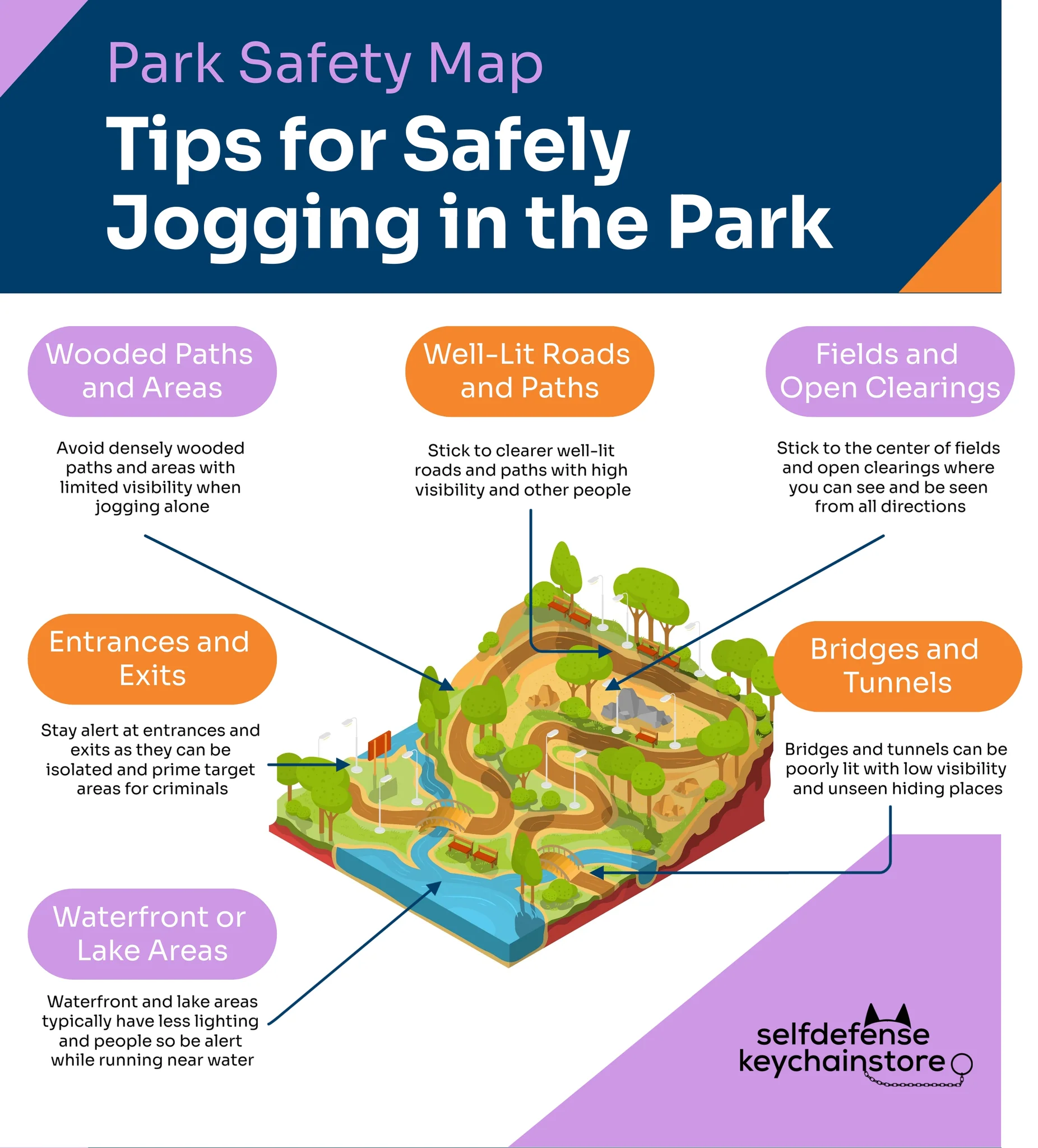
  • Park Safety Map for Joggers & Runners
    Use this park safety map to learn about the different areas of the park and their safety considerations.

    This is a general park safety map and all parks and outdoor environments may be different.

    Wooded Paths and Areas
    Wooded paths and dense areas of a park should generally be avoided if you're jogging because they possess natural seclusion and limited visibility.

    There is normally heavy tree cover, bushes and undergrowth, and winding trails which all lead to obscure sightlines and difficulty in using situational awareness and observing strangers from a distance.

    Due to their limited sunlight and rugged terrain, they are also often sparely populated which leads to less bystanders that can intervene if necessary.

    And the lack of lighting and quieter atmosphere provides cover for predators with bad intentions.

    Lastly, the uneven terrain and hidden roots or branches can be dangerous, making it harder to react quickly or change direction if you sense danger.

    Entrances and Exits
    Park entrances and exits can be dangerous for runners because they often involve transitioning through less populated isolated areas like parking lots or side streets.

    These "transition areas" are typically quieter, especially in the early morning or evening, making it easier for predators to stalk their victims. The lack of foot traffic and normal poor lighting also increases the risk of being targeted in these areas.

    Since people often let their guard down when arriving or leaving, runners may become more vulnerable in these areas. Staying alert, having your self-defense products ready, and avoiding lingering near entrances or exits can help reduce these risks.

    Waterfront or Lake Areas
    Waterfronts and lake areas can pose dangerous conditions for runners due to how desolate they can get and their natural terrain that's advantageous for predators.

    Running paths along lakes and waterways are often very desolate and contain few exit points since one whole side of the path is bordered by water. The other side is often bordered by dense woods or forest terrain which make running paths closed off with limited visibility.

    The variable terrain leading down from the normal ground to the water allows for favorable hiding spots for predators.

    The water's natural sounds and noises can also provide coverage for a predator.

    Well-Lit Roads & Paths
    Well-lit roads and paths are the best options for runners and joggers in parks at any hour of the day since they are normally the most populated and provide greater visibility even in darker settings.

    These well-lit areas are typically popular running routes and therefore discourage criminals from loitering in those areas. If something were to happen, there are normally bystanders or other runners in the area to call for help or personally intervene.

    Fields and Open Clearings
    Fields and open clearings are typically populated by families, children, and groups of adults, which make them great for running or jogging. The presence of recreational activities and gathering points increases the likelihood of bystanders and decreases the likelihood of violent crime.

    Open areas also provide a clear line of sight and greater visibility with less obstructions, which makes it easier to observe people from far away and evaluate their risk level.

    There's also more space to maneuver if someone were to present a risk, and you'd be provided with several different escape routes if necessary.

    Bridges and Tunnels
    Bridges and tunnels can be a potential area of concern for joggers due to their enclosed nature and limited visibility. A bridge or tunnel typically only has two ends and therefore only two escape routes if someone were to attack you.

    Bridges and tunnels also normally don't have much lighting or very poor lighting which hinders visibility. As mentioned earlier, the water's natural sounds provide coverage for a predator and added elements that can throw off a jogger.
    #armyourself
    Park Safety Map for Joggers & Runners Use this park safety map to learn about the different areas of the park and their safety considerations. This is a general park safety map and all parks and outdoor environments may be different. Wooded Paths and Areas Wooded paths and dense areas of a park should generally be avoided if you're jogging because they possess natural seclusion and limited visibility. There is normally heavy tree cover, bushes and undergrowth, and winding trails which all lead to obscure sightlines and difficulty in using situational awareness and observing strangers from a distance. Due to their limited sunlight and rugged terrain, they are also often sparely populated which leads to less bystanders that can intervene if necessary. And the lack of lighting and quieter atmosphere provides cover for predators with bad intentions. Lastly, the uneven terrain and hidden roots or branches can be dangerous, making it harder to react quickly or change direction if you sense danger. Entrances and Exits Park entrances and exits can be dangerous for runners because they often involve transitioning through less populated isolated areas like parking lots or side streets. These "transition areas" are typically quieter, especially in the early morning or evening, making it easier for predators to stalk their victims. The lack of foot traffic and normal poor lighting also increases the risk of being targeted in these areas. Since people often let their guard down when arriving or leaving, runners may become more vulnerable in these areas. Staying alert, having your self-defense products ready, and avoiding lingering near entrances or exits can help reduce these risks. Waterfront or Lake Areas Waterfronts and lake areas can pose dangerous conditions for runners due to how desolate they can get and their natural terrain that's advantageous for predators. Running paths along lakes and waterways are often very desolate and contain few exit points since one whole side of the path is bordered by water. The other side is often bordered by dense woods or forest terrain which make running paths closed off with limited visibility. The variable terrain leading down from the normal ground to the water allows for favorable hiding spots for predators. The water's natural sounds and noises can also provide coverage for a predator. Well-Lit Roads & Paths Well-lit roads and paths are the best options for runners and joggers in parks at any hour of the day since they are normally the most populated and provide greater visibility even in darker settings. These well-lit areas are typically popular running routes and therefore discourage criminals from loitering in those areas. If something were to happen, there are normally bystanders or other runners in the area to call for help or personally intervene. Fields and Open Clearings Fields and open clearings are typically populated by families, children, and groups of adults, which make them great for running or jogging. The presence of recreational activities and gathering points increases the likelihood of bystanders and decreases the likelihood of violent crime. Open areas also provide a clear line of sight and greater visibility with less obstructions, which makes it easier to observe people from far away and evaluate their risk level. There's also more space to maneuver if someone were to present a risk, and you'd be provided with several different escape routes if necessary. Bridges and Tunnels Bridges and tunnels can be a potential area of concern for joggers due to their enclosed nature and limited visibility. A bridge or tunnel typically only has two ends and therefore only two escape routes if someone were to attack you. Bridges and tunnels also normally don't have much lighting or very poor lighting which hinders visibility. As mentioned earlier, the water's natural sounds provide coverage for a predator and added elements that can throw off a jogger. #armyourself
    0 Comentários 0 Compartilhamentos 26K Visualizações
Patrocinado

AI-powered Business Social

Join Kiosk Social and get your business seen, build links, grow relationships, and have fun.