Have you heard of the “African unicorn”?
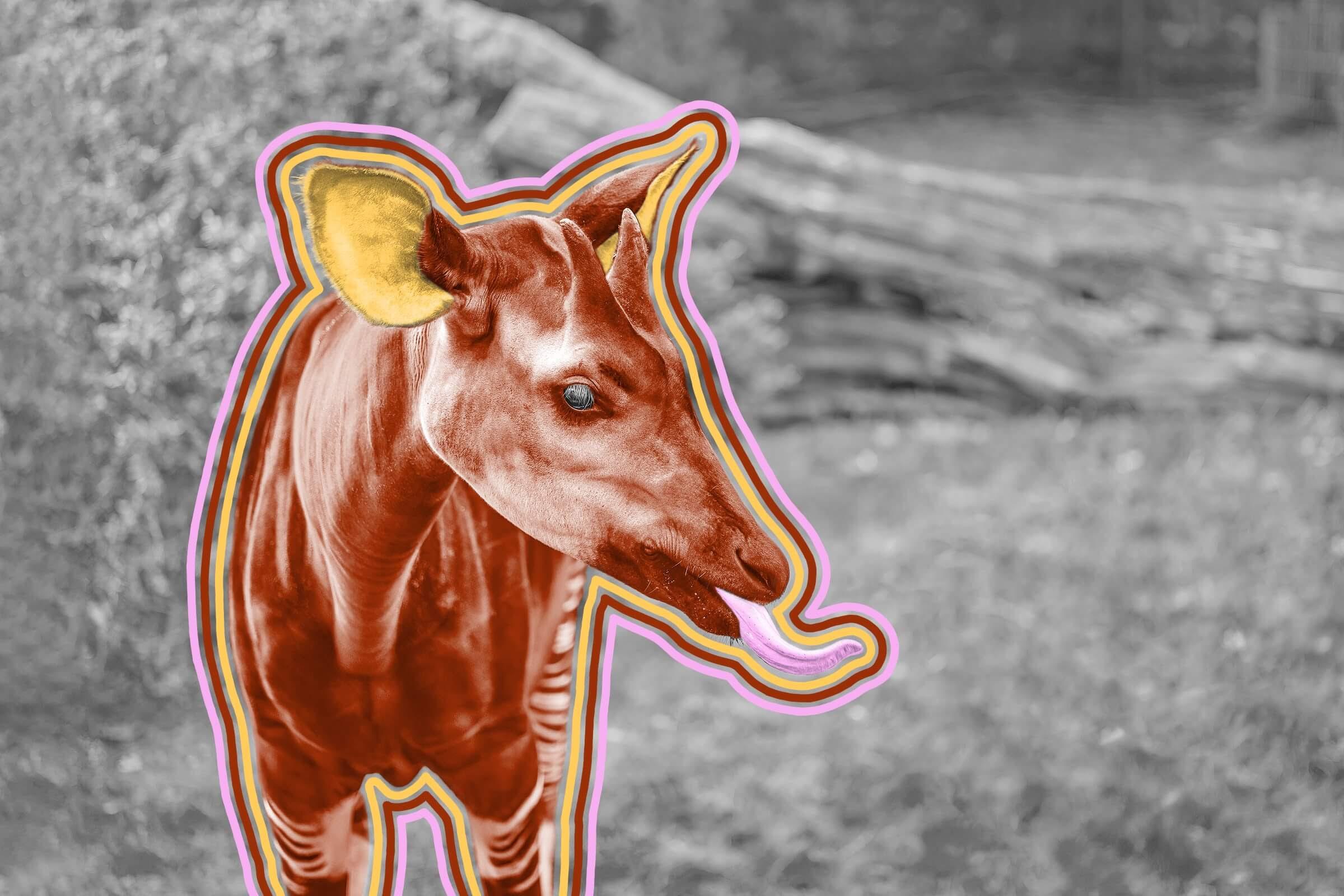
Okapis have tongues long enough to wash their eyelids.
The 6-foot-tall, roughly 500-pound, famously shy okapi (Okapia johnstoni) can only be found in the wild in the Ituri tropical rainforests of the Democratic Republic of Congo. Its biology features some amazing adaptations: A unique strip pattern on its rump helps the mammal blend in with shade cast by the rainforest canopy, and its fur is coated in a natural oil that repels moisture, something that rainforests obviously provide in abundance. What’s more, the okapi’s large ears can detect even the slightest disturbance, and okapi mothers communicate with their young in frequencies beyond human hearing. However, perhaps the okapi’s most useful evolutionary trait is its tongue. Stretching some 12 to 14 inches, it’s long enough to swat flies, clean the okapi’s ears, and even clean its eyelids. The tongue is also prehensile, meaning it can grasp and strip leaves from branches. This is immensely useful, as okapis can eat up to 60 pounds of food every day.
Although okapis live an isolated existence and look like a cross between a zebra and a deer, their tongues give away their genetic lineage. Okapis are the only living relatives of the giraffe, which explains the animal’s nicknames, including forest giraffe, Congolese giraffe, and zebra giraffe. Like okapis, giraffes also sport blue-hued prehensile tongues, and scientists estimate that the two species shared a common ancestry some 11 million to 12 million years ago. Today, unfortunately, okapis live under threat from deforestation, mining, armed militant groups, and hunting. Thankfully, groups like the Okapi Conservation Project are hard at work preserving the habitat of this “Congolese unicorn” for generations to come.
Rough length (in inches) of the average human tongue
3 Inches.
Weight (in pounds) of a blue whale’s tongue
8,000
Estimated number of okapis living in the Okapi Wildlife Reserve
3,500
Number of stomachs okapis have
4
Until 1901, Western scientists thought the okapi was a mythical creature.
For a mammal that can weigh hundreds of pounds, the scientific discovery of the okapi seems startlingly late. Throughout the 18th and 19th centuries, Western scientists heard about an “African unicorn” that some Congolese Indigenous peoples called o’api. However, because okapis live in hard-to-reach rainforests and are famously shy, experts dismissed the animal as simply a myth, a cryptid similar to the yeti of the Himalayas or the Sasquatch of the Pacific Northwest. However, in 1900, British explorer Sir Harry Johnston sent the first hide samples to the Zoological Society of London, and the okapi “myth” transformed into reality. Although finally “found” (at least by Western scientists; local tribes likely knew of the animal for millennia), traces of the okapi’s once-mythical status can still be seen — the creature serves as a mascot of sorts for the International Society of Cryptozoology. Because if the “African unicorn” is real, what else might science turn up next?
Have you heard of the “African unicorn”?
Okapis have tongues long enough to wash their eyelids.
The 6-foot-tall, roughly 500-pound, famously shy okapi (Okapia johnstoni) can only be found in the wild in the Ituri tropical rainforests of the Democratic Republic of Congo. Its biology features some amazing adaptations: A unique strip pattern on its rump helps the mammal blend in with shade cast by the rainforest canopy, and its fur is coated in a natural oil that repels moisture, something that rainforests obviously provide in abundance. What’s more, the okapi’s large ears can detect even the slightest disturbance, and okapi mothers communicate with their young in frequencies beyond human hearing. However, perhaps the okapi’s most useful evolutionary trait is its tongue. Stretching some 12 to 14 inches, it’s long enough to swat flies, clean the okapi’s ears, and even clean its eyelids. The tongue is also prehensile, meaning it can grasp and strip leaves from branches. This is immensely useful, as okapis can eat up to 60 pounds of food every day.
Although okapis live an isolated existence and look like a cross between a zebra and a deer, their tongues give away their genetic lineage. Okapis are the only living relatives of the giraffe, which explains the animal’s nicknames, including forest giraffe, Congolese giraffe, and zebra giraffe. Like okapis, giraffes also sport blue-hued prehensile tongues, and scientists estimate that the two species shared a common ancestry some 11 million to 12 million years ago. Today, unfortunately, okapis live under threat from deforestation, mining, armed militant groups, and hunting. Thankfully, groups like the Okapi Conservation Project are hard at work preserving the habitat of this “Congolese unicorn” for generations to come.
Rough length (in inches) of the average human tongue
3 Inches.
Weight (in pounds) of a blue whale’s tongue
8,000
Estimated number of okapis living in the Okapi Wildlife Reserve
3,500
Number of stomachs okapis have
4
Until 1901, Western scientists thought the okapi was a mythical creature.
For a mammal that can weigh hundreds of pounds, the scientific discovery of the okapi seems startlingly late. Throughout the 18th and 19th centuries, Western scientists heard about an “African unicorn” that some Congolese Indigenous peoples called o’api. However, because okapis live in hard-to-reach rainforests and are famously shy, experts dismissed the animal as simply a myth, a cryptid similar to the yeti of the Himalayas or the Sasquatch of the Pacific Northwest. However, in 1900, British explorer Sir Harry Johnston sent the first hide samples to the Zoological Society of London, and the okapi “myth” transformed into reality. Although finally “found” (at least by Western scientists; local tribes likely knew of the animal for millennia), traces of the okapi’s once-mythical status can still be seen — the creature serves as a mascot of sorts for the International Society of Cryptozoology. Because if the “African unicorn” is real, what else might science turn up next?






 English
 French
 Spanish
 Portuguese
 Deutsch
 Turkish
 Dutch
Dutch
 Italiano
 Russian
 Romaian
 Portuguese (Brazil)
 Greek
Greek