



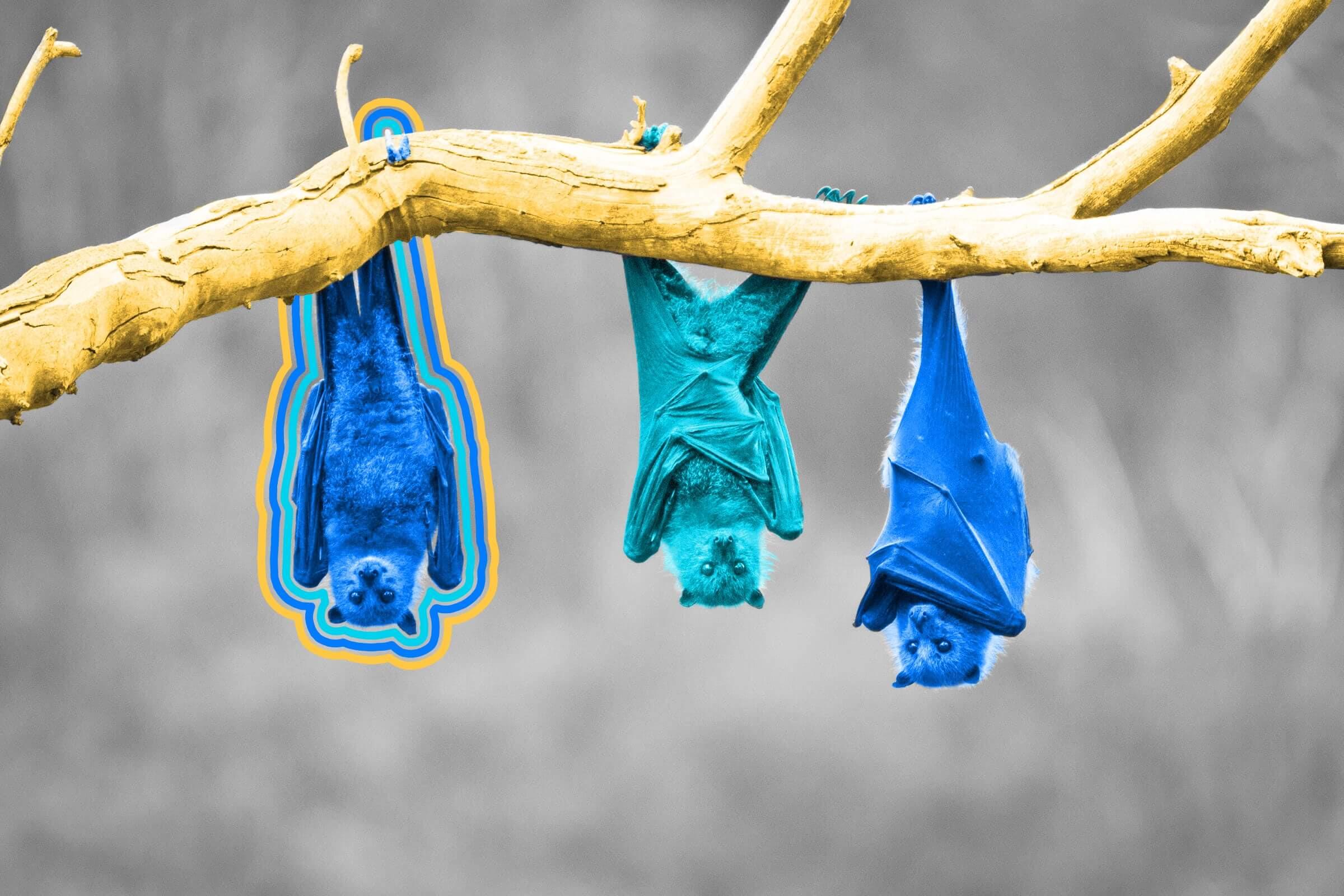
Bat species make up 21% of all mammals.
Earth is home to a staggering number of creatures: By one estimate, more than 8.7 million species of plants and animals live on its lands and in its waters. Mammals, however, make up a small fraction of that number — just 6,495 species. If you’re wondering which warm-blooded animals are most numerous, glance to the night sky. That’s where you’ll probably find bats, which account for 21% of all the mammals in the world.
The bat family boasts amazing diversity. The tiny bumblebee bat (only about an inch big) is the world’s smallest mammal, while the flying fox bat has a 5-foot wingspan. Scientists classify these mostly nocturnal creatures into two categories: microbats and megabats. Microbats are generally smaller, nighttime flyers that rely on echolocation to hunt insects, whereas megabats are often much larger, and some of them hunt in the daytime. Megabats primarily live in the tropics, where they use their larger eyes and better olfactory senses in place of echolocation to locate fruit for their meals.
Bats have been around for more than 50 million years, which helps explain why they’re such a fine-tuned part of our ecosystem. Nectar-eating bats are master pollinators of more than 500 plant species (including cacao for chocolate and agave for tequila), thanks to their ability to fly and transport pollen further than bees. They’re also nature’s bug zappers, keeping mosquito, moth, and beetle populations in check. The flying insect hunters are so effective — eating half their body weight in bugs each night — that scientists credit them with saving U.S. farmers $1 billion in pesticides and crop damage each year. Bats even help combat deforestation by dropping seeds over barren areas: Bat-dropped seeds can account for up to 95% of regrowth in cleared forests in tropical areas, a huge accomplishment for such small creatures.
Vampire bats create close friendships.
Vampire bats are at best feared and at worst maligned as sinister predators, but chiropterologists (scientists who study bats) believe Desmodus rotundus are actually incredibly social animals that survive thanks to their selective, long-term friendships. Vampire bats, which live in Mexico, Central America, and South America, have genetic mutations that separate them from their fruit- and bug-eating brethren, affecting how they taste and digest their food. They only survive on blood (usually from livestock and birds), and consume nearly 1.4 times their body weight per meal to get the nutrients they need. But blood isn’t always readily available, which puts vampire bats at risk of starvation, especially since they must eat every 48 hours or so. Researchers think this could be why these flying mammals have learned to share food with family members, regurgitating the substance in a manner similar to how birds feed their young. But vampire bats will also help roost-mates they have close, nonfamilial relationships with — and those bats remember and return the favor, creating a long-term bond that increases both animals’ odds of survival. Researchers say watching these high-flying friendships develop can help us better understand how other social species (like humans) bond, too.
Earth is home to a staggering number of creatures: By one estimate, more than 8.7 million species of plants and animals live on its lands and in its waters. Mammals, however, make up a small fraction of that number — just 6,495 species. If you’re wondering which warm-blooded animals are most numerous, glance to the night sky. That’s where you’ll probably find bats, which account for 21% of all the mammals in the world.
The bat family boasts amazing diversity. The tiny bumblebee bat (only about an inch big) is the world’s smallest mammal, while the flying fox bat has a 5-foot wingspan. Scientists classify these mostly nocturnal creatures into two categories: microbats and megabats. Microbats are generally smaller, nighttime flyers that rely on echolocation to hunt insects, whereas megabats are often much larger, and some of them hunt in the daytime. Megabats primarily live in the tropics, where they use their larger eyes and better olfactory senses in place of echolocation to locate fruit for their meals.
Bats have been around for more than 50 million years, which helps explain why they’re such a fine-tuned part of our ecosystem. Nectar-eating bats are master pollinators of more than 500 plant species (including cacao for chocolate and agave for tequila), thanks to their ability to fly and transport pollen further than bees. They’re also nature’s bug zappers, keeping mosquito, moth, and beetle populations in check. The flying insect hunters are so effective — eating half their body weight in bugs each night — that scientists credit them with saving U.S. farmers $1 billion in pesticides and crop damage each year. Bats even help combat deforestation by dropping seeds over barren areas: Bat-dropped seeds can account for up to 95% of regrowth in cleared forests in tropical areas, a huge accomplishment for such small creatures.
Vampire bats create close friendships.
Vampire bats are at best feared and at worst maligned as sinister predators, but chiropterologists (scientists who study bats) believe Desmodus rotundus are actually incredibly social animals that survive thanks to their selective, long-term friendships. Vampire bats, which live in Mexico, Central America, and South America, have genetic mutations that separate them from their fruit- and bug-eating brethren, affecting how they taste and digest their food. They only survive on blood (usually from livestock and birds), and consume nearly 1.4 times their body weight per meal to get the nutrients they need. But blood isn’t always readily available, which puts vampire bats at risk of starvation, especially since they must eat every 48 hours or so. Researchers think this could be why these flying mammals have learned to share food with family members, regurgitating the substance in a manner similar to how birds feed their young. But vampire bats will also help roost-mates they have close, nonfamilial relationships with — and those bats remember and return the favor, creating a long-term bond that increases both animals’ odds of survival. Researchers say watching these high-flying friendships develop can help us better understand how other social species (like humans) bond, too.
Bat species make up 21% of all mammals.
Earth is home to a staggering number of creatures: By one estimate, more than 8.7 million species of plants and animals live on its lands and in its waters. Mammals, however, make up a small fraction of that number — just 6,495 species. If you’re wondering which warm-blooded animals are most numerous, glance to the night sky. That’s where you’ll probably find bats, which account for 21% of all the mammals in the world.
The bat family boasts amazing diversity. The tiny bumblebee bat (only about an inch big) is the world’s smallest mammal, while the flying fox bat has a 5-foot wingspan. Scientists classify these mostly nocturnal creatures into two categories: microbats and megabats. Microbats are generally smaller, nighttime flyers that rely on echolocation to hunt insects, whereas megabats are often much larger, and some of them hunt in the daytime. Megabats primarily live in the tropics, where they use their larger eyes and better olfactory senses in place of echolocation to locate fruit for their meals.
Bats have been around for more than 50 million years, which helps explain why they’re such a fine-tuned part of our ecosystem. Nectar-eating bats are master pollinators of more than 500 plant species (including cacao for chocolate and agave for tequila), thanks to their ability to fly and transport pollen further than bees. They’re also nature’s bug zappers, keeping mosquito, moth, and beetle populations in check. The flying insect hunters are so effective — eating half their body weight in bugs each night — that scientists credit them with saving U.S. farmers $1 billion in pesticides and crop damage each year. Bats even help combat deforestation by dropping seeds over barren areas: Bat-dropped seeds can account for up to 95% of regrowth in cleared forests in tropical areas, a huge accomplishment for such small creatures.
Vampire bats create close friendships.
Vampire bats are at best feared and at worst maligned as sinister predators, but chiropterologists (scientists who study bats) believe Desmodus rotundus are actually incredibly social animals that survive thanks to their selective, long-term friendships. Vampire bats, which live in Mexico, Central America, and South America, have genetic mutations that separate them from their fruit- and bug-eating brethren, affecting how they taste and digest their food. They only survive on blood (usually from livestock and birds), and consume nearly 1.4 times their body weight per meal to get the nutrients they need. But blood isn’t always readily available, which puts vampire bats at risk of starvation, especially since they must eat every 48 hours or so. Researchers think this could be why these flying mammals have learned to share food with family members, regurgitating the substance in a manner similar to how birds feed their young. But vampire bats will also help roost-mates they have close, nonfamilial relationships with — and those bats remember and return the favor, creating a long-term bond that increases both animals’ odds of survival. Researchers say watching these high-flying friendships develop can help us better understand how other social species (like humans) bond, too.
0 Comentários
0 Compartilhamentos
6710 Visualizações



 English
 Arabic
 French
 Spanish
 Deutsch
 Turkish
 Dutch
Dutch
 Italiano
 Russian
 Romaian
 Portuguese (Brazil)
 Greek
Greek