Why each tiger's stripes are one of a kind.
The pattern of every tiger’s stripes is unique.
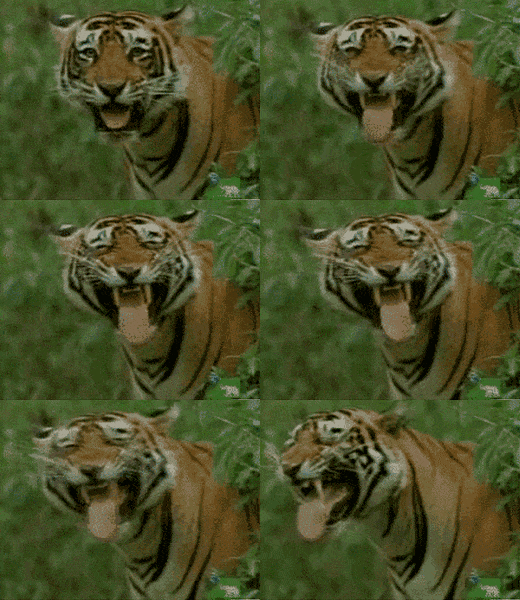
Not unlike human fingerprints, the pattern of every tiger’s stripes is one of a kind. And though those markings are invariably beautiful, they aren’t just for decoration. Biologists refer to tiger stripes as an example of disruptive coloration, as their vertical slashes help them hide in plain sight by breaking up their shape and size so they blend in with tall grass, trees, and other camouflage-friendly environments. Tigers are solitary hunters who ambush their prey, so the ability to remain undetected while on the hunt is key to their survival.
They’re also helped by the fact that their prey don’t see colors the way we do. Deer, for instance, can process short and mid-wavelength colors such as green and blue but not long wavelength hues such as red and orange. That means a tiger lurking in the grass won’t look bright orange — it will actually appear green to its prey, making it difficult to differentiate from its surroundings. Markings also differ among subspecies, with Sumatran tigers having the narrowest stripes and Siberian tigers having fewer than the rest of their big cat brethren.
Tigers have stripes on their skin as well as their fur.
It isn’t just a tiger’s fur that’s striped. Their skin is similarly marked, and the pattern mirrors that of their fur. Scientists have compared this to a beard’s five-o’clock shadow, as a tiger’s colored hair follicles are embedded in their skin and therefore visible to the naked eye. Here, too, we have something in common with these majestic creatures: Our skin is covered in a kind of stripes as well, called Blaschko’s lines, but ours are usually invisible except in the case of certain skin conditions.
Why each tiger's stripes are one of a kind.
The pattern of every tiger’s stripes is unique.
Not unlike human fingerprints, the pattern of every tiger’s stripes is one of a kind. And though those markings are invariably beautiful, they aren’t just for decoration. Biologists refer to tiger stripes as an example of disruptive coloration, as their vertical slashes help them hide in plain sight by breaking up their shape and size so they blend in with tall grass, trees, and other camouflage-friendly environments. Tigers are solitary hunters who ambush their prey, so the ability to remain undetected while on the hunt is key to their survival.
They’re also helped by the fact that their prey don’t see colors the way we do. Deer, for instance, can process short and mid-wavelength colors such as green and blue but not long wavelength hues such as red and orange. That means a tiger lurking in the grass won’t look bright orange — it will actually appear green to its prey, making it difficult to differentiate from its surroundings. Markings also differ among subspecies, with Sumatran tigers having the narrowest stripes and Siberian tigers having fewer than the rest of their big cat brethren.
Tigers have stripes on their skin as well as their fur.
It isn’t just a tiger’s fur that’s striped. Their skin is similarly marked, and the pattern mirrors that of their fur. Scientists have compared this to a beard’s five-o’clock shadow, as a tiger’s colored hair follicles are embedded in their skin and therefore visible to the naked eye. Here, too, we have something in common with these majestic creatures: Our skin is covered in a kind of stripes as well, called Blaschko’s lines, but ours are usually invisible except in the case of certain skin conditions.












 English
 Arabic
 Spanish
 Portuguese
 Deutsch
 Turkish
 Dutch
Dutch
 Italiano
 Russian
 Romaian
 Portuguese (Brazil)
 Greek
Greek