



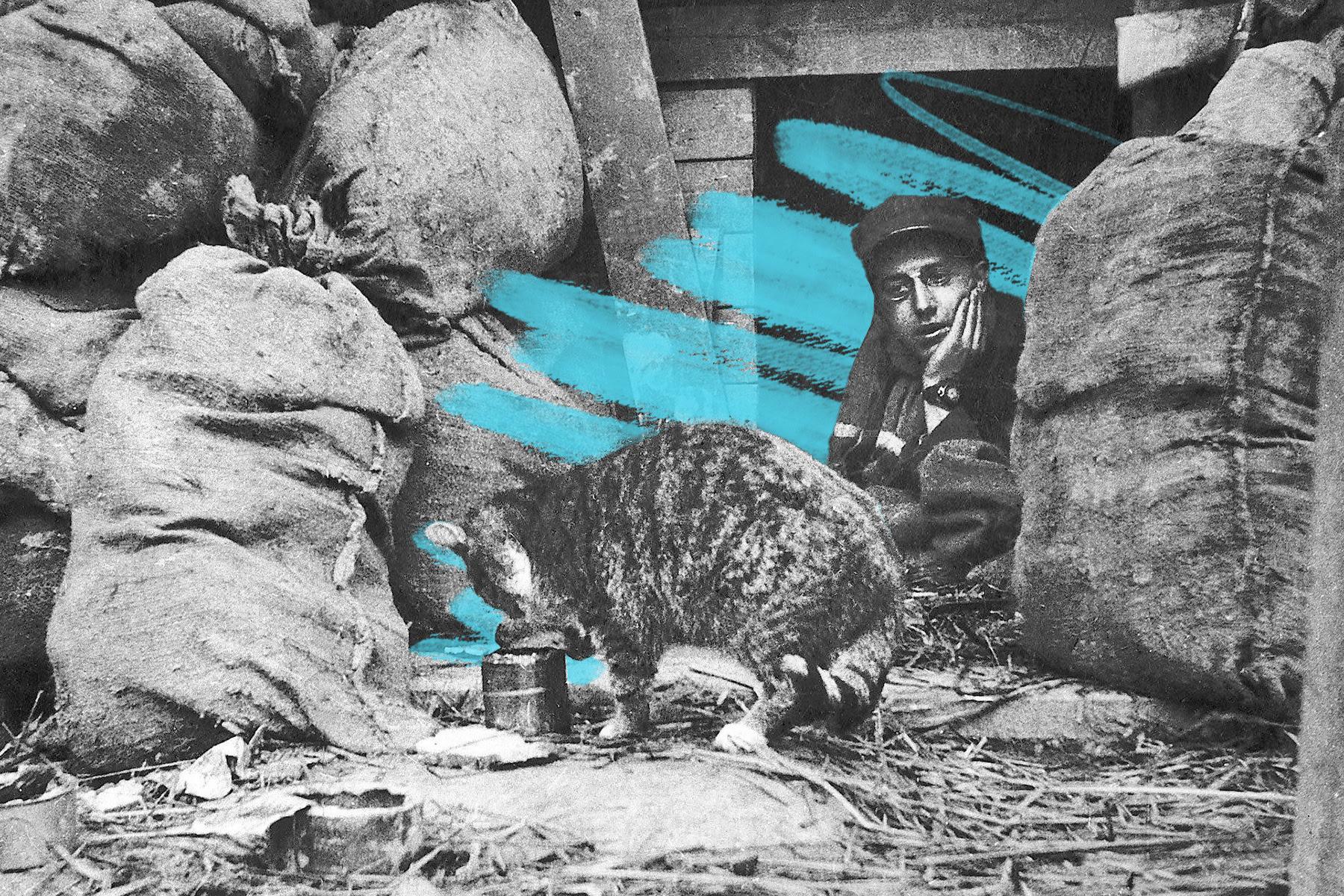
Why cats were in WWI trenches.
The Great War was such a difficult time, some soldiers sought out the assistance and comfort of four-legged friends — including cats, who were used in the trenches to boost morale. Dogs, homing pigeons, foxes, goats, lion cubs, and even raccoons also served their countries as pets and mascots throughout the “war to end all wars,” and some even carried out official duties. Cats did a bit of both: Though most kitties simply kept their compatriots in good spirits by providing them with loyal companionship (and fending off rats), some also used their heightened sense of atmospheric pressure to detect bombs in advance.
Not all feline soldiers’ deeds have gone unnoticed. Among the 75 animals who have received the PDSA Dickin Medal, which was established in 1943 to honor the military service of animals, is a cat named Simon. He served aboard the HMS Amethyst from 1948 to 1949 and received the medal for “disposing of many rats though wounded by shell blast. Throughout the incident his behavior was of the highest order, although the blast was capable of making a hole over a foot in diameter in a steel plate.” In a newsreel of the ship returning home, Simon is rightly referred to as “a hero in his own right.”
Cats who served in World War I
500,000
Animals who served in World War I
16 million
Kittens produced by Dusty, a tabby cat born in 1935
420
Age of Creme Puff, the oldest known cat
38
Did you know?
Calico cats are considered good luck.
That’s the reason maneki-neko are so often depicted as calicos. The “beckoning cat” figurines found throughout Japan and at Japanese and Chinese establishments around the world are intended as tokens of good fortune, with one of their paws raised high in a waving motion. This dates back to the tradition of Japanese sailors traveling with calicos to bring about safe passage — the multicolored cats were believed to be able to chase away storms and ancestral ghosts. In the United States and England, meanwhile, male calicos are considered especially lucky because of their rarity.
The Great War was such a difficult time, some soldiers sought out the assistance and comfort of four-legged friends — including cats, who were used in the trenches to boost morale. Dogs, homing pigeons, foxes, goats, lion cubs, and even raccoons also served their countries as pets and mascots throughout the “war to end all wars,” and some even carried out official duties. Cats did a bit of both: Though most kitties simply kept their compatriots in good spirits by providing them with loyal companionship (and fending off rats), some also used their heightened sense of atmospheric pressure to detect bombs in advance.
Not all feline soldiers’ deeds have gone unnoticed. Among the 75 animals who have received the PDSA Dickin Medal, which was established in 1943 to honor the military service of animals, is a cat named Simon. He served aboard the HMS Amethyst from 1948 to 1949 and received the medal for “disposing of many rats though wounded by shell blast. Throughout the incident his behavior was of the highest order, although the blast was capable of making a hole over a foot in diameter in a steel plate.” In a newsreel of the ship returning home, Simon is rightly referred to as “a hero in his own right.”
Cats who served in World War I
500,000
Animals who served in World War I
16 million
Kittens produced by Dusty, a tabby cat born in 1935
420
Age of Creme Puff, the oldest known cat
38
Did you know?
Calico cats are considered good luck.
That’s the reason maneki-neko are so often depicted as calicos. The “beckoning cat” figurines found throughout Japan and at Japanese and Chinese establishments around the world are intended as tokens of good fortune, with one of their paws raised high in a waving motion. This dates back to the tradition of Japanese sailors traveling with calicos to bring about safe passage — the multicolored cats were believed to be able to chase away storms and ancestral ghosts. In the United States and England, meanwhile, male calicos are considered especially lucky because of their rarity.
Why cats were in WWI trenches.
The Great War was such a difficult time, some soldiers sought out the assistance and comfort of four-legged friends — including cats, who were used in the trenches to boost morale. Dogs, homing pigeons, foxes, goats, lion cubs, and even raccoons also served their countries as pets and mascots throughout the “war to end all wars,” and some even carried out official duties. Cats did a bit of both: Though most kitties simply kept their compatriots in good spirits by providing them with loyal companionship (and fending off rats), some also used their heightened sense of atmospheric pressure to detect bombs in advance.
Not all feline soldiers’ deeds have gone unnoticed. Among the 75 animals who have received the PDSA Dickin Medal, which was established in 1943 to honor the military service of animals, is a cat named Simon. He served aboard the HMS Amethyst from 1948 to 1949 and received the medal for “disposing of many rats though wounded by shell blast. Throughout the incident his behavior was of the highest order, although the blast was capable of making a hole over a foot in diameter in a steel plate.” In a newsreel of the ship returning home, Simon is rightly referred to as “a hero in his own right.”
Cats who served in World War I
500,000
Animals who served in World War I
16 million
Kittens produced by Dusty, a tabby cat born in 1935
420
Age of Creme Puff, the oldest known cat
38
Did you know?
Calico cats are considered good luck.
That’s the reason maneki-neko are so often depicted as calicos. The “beckoning cat” figurines found throughout Japan and at Japanese and Chinese establishments around the world are intended as tokens of good fortune, with one of their paws raised high in a waving motion. This dates back to the tradition of Japanese sailors traveling with calicos to bring about safe passage — the multicolored cats were believed to be able to chase away storms and ancestral ghosts. In the United States and England, meanwhile, male calicos are considered especially lucky because of their rarity.











 English
 Arabic
 French
 Portuguese
 Deutsch
 Turkish
 Dutch
Dutch
 Italiano
 Russian
 Romaian
 Portuguese (Brazil)
 Greek
Greek